


Inspired by European guidebooks, this author created a tour book of Ohio's historic earthworks
Listen to this Episode
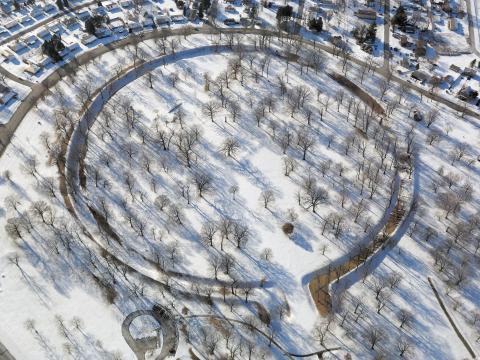
Ohio is home to an estimated 500 earthworks, created by Native American groups like the Hopewell over 2,000 years ago. Often large in scale, the architectural structures are made of mounded dirt, clay and other raw materials.
"They were built for ceremonial purposes," John Hancock, professor emeritus of architecture at the University of Cincinnati said. "They were not forts, they were not cities. They were built as sacred spaces for these American Indian ancestors."
A group of these ancient structures, the Hopewell Ceremonial Earthworks in Chillicothe, Newark and Oregonia, were designated as Ohio's only UNESCO World Heritage Site in 2023.
Hancock published two books on Ohio earthworks this spring: "Traveler's Guide to Ancient Ohio," and "Hopewell Ceremonial Earthworks: Landscape Monuments of the Ancient Ohio Valley."
Hancock's career as a professor spans four decades: He's taught architecture, design and architectural history. He has studied earthworks since the 1990s and was a driving force behind The Hopewell Ceremonial Earthworks being designated as a UNESCO World Heritage Site.
Hancock joined the Ohio Newsroom to talk about his new books.
This interview was lightly edited for clarity and brevity.
On writing a guidebook
"I had done a lot of European travel before, for the first half of my career. When I first discovered that these earthworks existed across mostly the southern half of our state, I went out looking for them and I discovered not only were they spectacular and surprising, but there's all these beautiful historic towns and scenic drives and nature parks and everything else. I thought, well, this is a potential tourist region here like some of those places I've been to in Europe, so it should have a guidebook that's as good as you can get when you go over there.
On viewing the earthworks
"[Earthworks] can be elusive because sometimes if you're there at the wrong time of year and it's in the woods, you won't see it. Or if you don't know where to look for the other side of this gigantic enclosure, you won't see it. So [the guidebook is] a visual orientation to what to look at, how to find the piece that needs interpreting and then to offer the stories to go with it. In short, I call it stories in places."
On working with Native American communities
"Ohio is a state from which all tribes were expelled. We have tribal citizens living in Ohio, but we don't have any tribes based in Ohio. So who to talk to, and who to listen to, was a very complicated question in the early years [of research]. We talked to Native citizens who lived in Ohio. And we also took some trips to Oklahoma to interview people with the displaced tribes, the Shawnee, the Miami and the Delaware especially."
On the UNESCO World Heritage designation
"[My second book] is directly related to the UNESCO World Heritage process and to mainly just those eight earthworks sites that were part of the nomination. Its main function is to describe those sites, their histories, their form and sophistication and how they met the criteria for world heritage: How they give evidence to the culture and how they give evidence to the genius-level knowledge and skill – you might almost call it technology – of these amazing ancient people. The biggest thing that stands out is how sophisticated the designs of these earthworks are in terms of precision geometry executed at a huge scale and then repeated across the region at sites very far apart."
On being a tourist in Ohio
"Ohioans should go to these places because that's a layer of our heritage in this region that has been little known until recently. It has aspects to it which are literally unbelievable about these sites. Their precision and their beauty and their scope are really quite amazing. And many of the other things about our Ohio landscapes — the scenic places, the natural places, the historic places — actually form a background to the interpretation of the sites because the natural setting is an important part of why they're here. The historic towns, places like Chillicothe and so forth are important to the history of how the sites were discovered by the settlers and interpreted. So all these layers of history in our region pile up together.
"I think it's a matter of appreciation. We live here with these rivers and hills and valleys and towns. It's a matter of learning how to pay attention more closely, how to be mindful and appreciative of the beauty that's here. And not thinking that you have to go far away to have historic sites or historic towns or beautiful hills or great monuments that are of world-class significance. It's all right here."