


Nearly 3,000 acres of Ohio's only national forest auctioned off for oil and gas development
Listen to this Episode
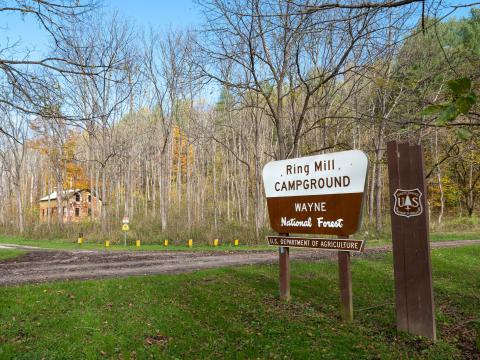
The U.S. Department of Interior's Bureau of Land Management has leased nearly 3,000 acres of the Wayne National Forest to oil and gas companies. Critics warn the move could be damaging to the region, but industry officials say the project is needed to help the nation meet its energy needs.
The Bureau announced its plans to lease the land in July. Following a mandatory protest period, 40 parcels within the Wayne National Forest were sold in an online auction on Tuesday. The sales totaled over $11 million.
The highest bid was nearly $10,000 per acre on a parcel in Monroe County.
Nathan Johnson, attorney of land and water for the Ohio Environmental Council, said the scale of the projects could radically change the area.
"We are talking about pipelines. We are talking well pads," Johnson said. "We're talking [about a] huge increase in truck traffic. We're talking about major increases in air pollution as well."
A history of deforestation
This isn't the first time the Wayne National Forest has seen industrial changes. In the 19th and 20th centuries, the logging, mining and farming industries all cleared large swaths of forest land in the region.
Ecologist Glen Matlack with Ohio University says the area still hasn't fully recovered.
"It takes a while to accumulate a whole forest community, to put together the entire forest. A forest is not just the trees that grow in the forest," Matlack said.
Matlack has found small patches of forest herbs growing in the national forest. The native plants grow underneath established tree canopies and are a nutrient resource for wildlife. Matlack says the infrequency of the herbs is indicative of past deforestation.
"You can still recognize the history of disturbance in a forest patch here by the poverty of forest species in it," Matlack said.
Private land owners may profit
The Wayne National Forest is home to several endangered species like the Indiana Bat. Because they're protected, federal agencies can't take actions that would put them at further risk.
Mike Chadsey, director of external affairs for the Ohio Oil and Gas Association, says oil and gas companies generally prefer to work with private landowners who have already clear cut their fields, instead of taking down trees in the national forest. That way they don't have to worry about violating federal laws that protect endangered species.
"The vast majority of these well pad locations, they are going to be on private property," he said. "When you try to take down trees you can only have a small window to do that because of Indiana bats and various other species that reside in those trees."
Some private properties in Monroe and Washington Counties are surrounded by national forest land. Chadsey says opening up the forest for oil and gas development allows those landowners to lease their mineral rights, many for the first time.
Chadsey says some forest land will likely still need to be cleared for pipelines — and there's no guarantee the oil and gas companies won't place well pads in the Wayne — but he says the impact should be minimal.
"We have to be mindful of truck traffic, we have to be mindful of pipelines. So here's all the things that are involved. We are aware of them. We don't think that's a negative impact to the forest," Chadsey said.
Overall, he thinks the development will be positive for the entire state, as thousands of products can be made from crude oil and gas.
"To be able to use that as a feedstock for manufacturing is huge for Ohio and West Virginia, because these are states that make things," Chadsey said.
Cause for concern
The Ohio Environmental Council doesn't think oil and gas drilling is worth the risk to the land.
"That's a huge chunk of public land for context. I mean, that's larger than Cuyahoga Valley National Park," Ohio Environmental Council Attorney Nathan Johnson said. "It is larger than the largest state park in Ohio. It's more than 30,000 football fields."
“If we want to have summer temperatures below 100 degrees Fahrenheit, we need to have the trees here."
The Ohio Environmental Council filed a lawsuit claiming the Bureau of Land Management is violating several environmental laws by leasing federal forest land, and filed an official protest ahead of the auction.
Johnson said the Council is likely to file another suit now that the auction has taken place. The Council also argues the Bureau's environmental studies neglected to fully consider the wells' impact on air quality.
Ecologist Glen Matlock says opening up the area is especially concerning considering trees are natural air filters. They also naturally produce moisture, which cools the air.
In a press release, the Bureau of Land Management stated this week's auction is only the first step of the process. Companies leasing the land still have to submit a drilling permit application, which the Bureau has to approve.
Ohio isn't the only state where federal land is up for lease. The Bureau of Land Management is also putting National Forest land in New Mexico up for bid, along with land in Texas, Oklahoma, Colorado and several other states.