


A beetle that nearly went extinct is getting back to burying carcasses in Ohio
Listen to this Episode
The United Titanium Bug Zoo at Ohio State University's campus in Wooster is full of creepy, crawly critters in extra large sizes: hairy tarantulas, cave cockroaches and giant millipedes.
But at least one bug among them is much smaller.
"What do you say, maybe two inches long? An inch and a half?" Jeni Filbrun estimated.
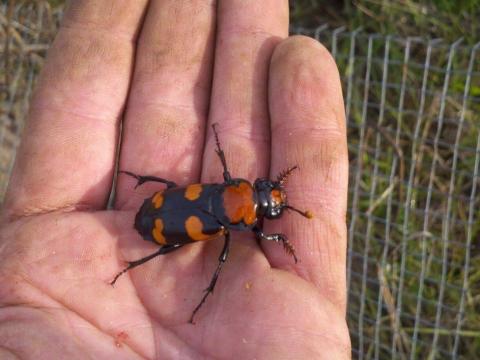
Filbrun, the facility's manager and zookeeper, held a shiny black and orange beetle in the palm of her gloved hand. She loves all bugs, but has a special affinity for the American burying beetle.
"They have the cutest little orange antennas," she said.
Once common in Ohio, the American burying beetle nearly went extinct a few decades ago.
Now, Filbrun is working with conservationists at the Cincinnati Zoo and Botanical Gardens and The Wilds to help re-establish a population in the Buckeye state.
'Nature's undertakers'
The American burying beetle once roamed across 35 states, from Rhode Island to Texas. But their population drastically declined in the early to mid-1900s. Starting in the '70s, none were found naturally in Ohio for around 40 years.
"Their food sources are more scarce with all the urbanization," Filbrun said. "They're attracted to light, also. So a lot of our light pollution has pulled them away from their actual habitats."
In 1989, the beetle was among the first insects to be placed on the federal endangered species list.
That might be welcome news for someone with entomophobia, but the bug plays an important role in the ecosystem.
Like their name suggests, American burying beetles find – and bury – small dead animals like pigeons or chipmunks, by digging up the dirt beneath them so their carcasses sink into the ground. Instead of getting picked off by scavengers, the corpses' nutrients get recycled back into the soil.
Additionally, the beetles help control fly populations.
"They are eating things that live on dead animals," Filbrun said.
Reintroducing the threatened species
For years, groups like the Cincinnati Zoo and Botanical Gardens and The Wilds have been working to reintroduce American burying beetles to the state. Now, Ohio State's Bug Zoo is joining the effort.
"This is where we did all the breeding," Filbrun said in a dark room filled with carefully labeled plastic boxes.
She handled the matchmaking process with care, starting by strategically pairing up the beetles according to a plan set by researchers. This helps ensure their babies will be genetically diverse and therefore more likely to survive.
Then, she placed the pairs in a five gallon bucket filled with dirt and a dead rat. They get busy right away, burying the vermin and laying their eggs nearby.
"If you and I wanted to bury something, it's like us burying a bull elephant in 12 hours with no tools," Filbrun said.
The beetles also remove the dead animals' fur or feathers and coat it with excretions to make a sort of rat meatball. It's a way to preserve the feast for their soon-to-hatch eggs.
After about two months, nearly 200 of them will have transformed into adult beetles.
They'll be released at The Wilds later this month.
Not all of them will make it. In fact, it took a decade of trying before scientists found evidence of a few beetles surviving the Ohio winter in the wild. But successful efforts since 2019 have scientists hopeful.
After releasing a record number of American burying beetles at the site last year, they later captured over a hundred — a sign that the threatened species is making its digs in Ohio once again.