


Elk haven't been in Ohio in a hundred years. One state rep wants them back
Listen to this Episode
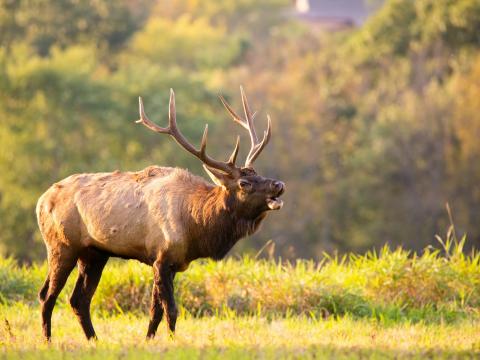
Long ago, elk roamed the wooded-areas of Ohio. But after years of deforestation and over-hunting, the last native eastern elk was killed in Ashtabula in 1840.
Now, more than a century later, one state legislator wants to give the large deer-like animal another shot.
State representative Justin Pizzulli, R-Scioto County, introduced a bill that would fund a $1.5 million study on the reintroduction of elk.
HB641 would mandate that the Ohio Department of Natural Resources (ODNR) conduct a study of habitat suitability, ecological risks, logistics of sourcing and relocating elk and long-term management strategies.
"It has the potential to create a large economic investment into our state," Pizzulli said. "They're beautiful creatures that I think people want to see."
Why should Ohio bring elk back?
Hunting is a billion dollar industry in Ohio, according to a 2023 report commissioned by the Ohio Division of Wildlife. Pizzulli believes elk hunting, in particular, has the potential to revitalize many rural towns in Ohio – especially in the southeast corner of the state.
"Down in my neck of the woods, we're always looking for additional revenues," Pizzulli said.
In neighboring states, elk have boosted small towns. In Kentucky, the state's Division of Wildlife has boasted millions in economic impact from elk hunting. In Pennsylvania, local media outlets have reported on a tourism boom to areas where elk have been reintroduced.
"There have been many towns in Kentucky, West Virginia, Pennsylvania, that have introduced elk, and they're seeing these little towns, that were once ghost towns, start to pop up with gas stations [and] restaurants," he said.
What does the Ohio Department of Natural Resources think?
In a statement to the Ohio Newsroom, the Ohio Department of Natural Resources said any current conversation regarding the reintroduction of elk must take into account Chronic Wasting Disease (CWD).
"[CWD] was found in Ohio in a wild deer herd in 2020 and has continued to spread. Elk are susceptible to CWD, and elk in other states are now testing positive for CWD. If future studies regarding elk reintroduction in Ohio move forward, we would recommend that the threat of CWD be weighed as part of any recommendations," a department spokesperson wrote.
Pizzulli said his proposed study specifically calls for investigating how elk would impact the disease. He believes CWD alone is not reason enough to squash the idea.
"Ohio already has so many protocols in place such as quarantine phases for deer and other species," he said. "To say 'We shouldn't introduce a new species because there's a disease' is like saying 'I shouldn't go hiking because there is Lyme disease out there.'"
Does Ohio have the habitat to support the species?
A 2015 study commissioned by the Ohio Department of Natural Resources found that habitat in much of southeastern and east central Ohio is capable of supporting reintroduced populations of elk.
The study found that the real challenges come from elk-human interactions, like crop damage or vehicle collisions with the animal. It recommended reintroduction in small, restricted areas.
Pizzulli said the study will determine what sort of other tradeoffs exist. But, ultimately, he believes the state will get a return on its investment.
"We have to be innovative in this state. People are tired of the status quo. So we need to be looking at innovative ideas. Not only conservation, but to bring tourism dollars back to the poorest corners of the state."