


How a proposed bill could help homebound Ohio seniors access food assistance
Listen to this Episode
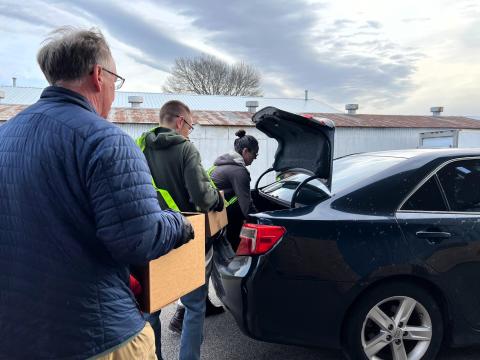
On the second Friday of March, a steady stream of DoorDash drivers lined up outside Shared Harvest Foodbank in Fairfield, a small city north of Cincinnati.
Instead of restaurant takeout, volunteers squeezed cardboard boxes full of shelf-stable groceries into their back seats.
Program coordinator Lily Austin leaned toward an open car window.
"So you have 10 deliveries today?" she asked the driver, before instructing him on the distribution process.
"These are for homebound senior citizens who receive a monthly food box from us. Each individual person, they will receive one of these big, brown, 40-pound boxes and each individual person will get one of these blocks of cheese," she said.
Shared Harvest Foodbank started distributing food this way during COVID, and the practice has stuck around. They still deliver nearly 500 boxes of food to homebound seniors each month.
A proposed piece of federal legislation could help them serve even more.
The Delivering for Rural Seniors Act
Sens. Jon Husted (R-Ohio) and Mark Kelly (D-Ariz.) introduced the Delivering for Rural Seniors Act in January. It would create a three-year pilot program to expand home delivery options for the Commodity Supplemental Food Program.
That's a federal initiative to provide nutritional assistance to seniors older than 60 with incomes at or below 150% of the poverty line, and it's what funds the boxes of cereal, canned vegetables and juice that Shared Harvest and other food banks distribute each month.
Around 30,000 Ohioans are eligible for the aid. But some struggle to pick it up.
"In Butler County, specifically, we get people who don't have transportation, they have medical issues," said Robert Zohfeld, the director of programs for Shared Harvest Foodbank.
As Ohio's population ages, he says the need for door-step delivery is high. But their current program has a limited reach.
"Where the DoorDashers specifically pick up, they can deliver 10 miles as a crow flies," he said.
That leaves around 2,000 square miles of their five-county service area without a delivery option.
The need for home delivery
The problem is especially noticeable in southeast Ohio, where the rural geography means many people live at least 30 minutes away from the closest grocery store.
"We know that seniors across the state of Ohio struggle with mobility challenges, with access to public transportation, with having access to a vehicle or someone that can give them a ride," said Alicia Miklos, director of the SE Ohio Foodbank.
"That is just really compounded in southeast Ohio. Even if there's a mobile distribution happening in their county, it can still be really difficult for them to get to a source of food," she said.
Last year, about a quarter of the people the SE Ohio Foodbank served were seniors. Miklos says that number is higher than it's been in the past.
"Living on a fixed income means that they are struggling to keep up with the rising cost of living and they're making difficult choices between paying utility bills, buying food or even paying for medications," she said. "So we just know that food bank programs that cater to that senior population are a lifeline right now for people facing the heightened cost of living."
Like Shared Harvest Foodbank in Butler County, the SE Ohio Foodbank has also found a way to deliver senior boxes to the homebound: by partnering with a Meals on Wheels program in Hocking and Athens counties.
More funding would help them expand that service to the eight other counties the food bank serves, Miklos said.
The impact of home delivery
Instead of using DoorDash or working with Meals on Wheels, Second Harvest Food Bank of North Central Ohio relies on a fleet of 80 volunteers to distribute senior boxes to the elderly.
Erin Moore-Ondich is the senior programs and CSFP program coordinator there. She sees the impact of home delivery first-hand.
"Maybe [a senior does] have a vehicle, but they have to choose between, 'Am I going to fill up my car with gas, or get my medicine and go to the doctor, or wait in a food line for a long time,'" she said.
Others care for their grandchildren, so they have to be at home during the day.
Rosalie Martin, a former social worker, says she deals with painful arthritis.
"And some days you just don't move too well," she said. "So having them deliver it is fantastic because I don't have any family here. They're all on the west side of Cleveland. So I'm pretty much on my own out here."
With additional funding, Moore-Ondich says Second Harvest Food Bank could help more people like Martin.
"There is definitely a huge need," she said. "I have calls coming in every day. I'm doing applications almost every day."
For now, the Delivering for Rural Seniors Act has been referred to the Senate Committee on Agriculture, Nutrition and Forestry.