


Rural America is gaining residents. Here's how Ohio fits into the national picture
Listen to this Episode
This story was originally published in The Daily Yonder, a national news organization covering rural people and places.
Thousands of people moved to rural America last year, resulting in the fifth year of continual population growth in nonmetropolitan counties, according to my analysis of new data from the Census Bureau. But that growth has been driven by only a subset of counties, while many persistently poor regions continue to lose people.
Last year, 168,000 new residents moved to nonmetropolitan, or rural, counties – down from 255,000 the year before, but still big enough of a gain to offset the decline in population caused by deaths outpacing births, known as natural decrease. (Natural increase, on the other hand, occurs when births outnumber deaths).
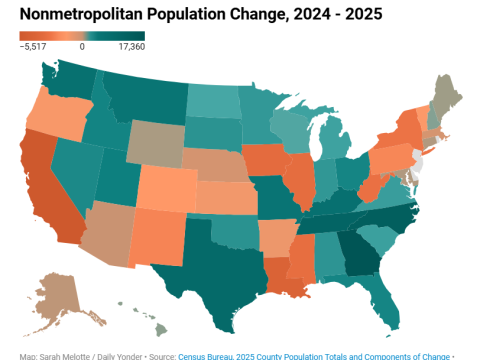
The map above shows rural population change at the state level. Data for this analysis comes from the 2025 County Population Totals and Components of Change report, an annual dataset produced by the Census Bureau.
Between 2024 and 2025, rural America gained 75,000 residents, slowing slightly from last year's gain of 134,000. Net migration to rural America resulted in 167,900 new residents, but those gains were offset by a natural decrease of nearly 92,000 people. Approximately 53,000 of those newcomers were from abroad.
Thirty out of the 48 states that have nonmetropolitan counties saw rural population growth last year. Twenty-three out of those 30 states saw rural natural decline and would not have gained a rural population if it were not for in-migration.
Growth and Decline in Rural Counties
There are two ways to understand this data.
- At a national level, rural America is growing, which is a positive economic signal.
- But that growth is uneven; only about half of rural counties gained population last year, while the other half continued to shrink, many of them persistently.
Coming after a decade of steady population decline, the recent growth in rural America's population is good news. Population loss rarely bodes well for any place, but is especially harmful to small towns, and often signals deeper economic and social challenges. But whenever I see promising data on rural America, I wonder what things look like at a finer scale. Is this phenomenon unevenly distributed across the country? If so, where does the general trend not hold true?
I've written extensively about how rural counties dependent on recreation and tourism often fare better on a range of economic and demographic indicators, including population growth. In recent years, these places have led the way in job recovery and in-migration. I've also used IRS data to show how, in some Mountain West resort towns, an influx of wealthy newcomers is displacing lower-income families. Given this pattern, I wondered whether this recent growth was concentrated in places already attracting more affluent people.
But that doesn't seem to necessarily be the case. Population growth is happening across almost all economic industries, not just in tourism-driven economies. The county economic types are based on typologies created by the Economic Research Service (ERS), a branch of the USDA, which places each county into one of six mutually-exclusive categories as follows:
- Rural counties where the local or federal government drives the economy saw a population increase of 14,000 last year.
- Rural counties where mining and natural resource extraction drives the local economy saw population decline, losing 2,800 residents last year.
- In rural counties where manufacturing was the dominant industry, the population increased by nearly 23,000.
- Population growth in farming-dependent counties was 2,600 last year.
- In rural counties where the local economy is driven largely by recreation and tourism, the population grew by about 11,000.
- In places where no single industry dominates the local economy, population growth equaled 27,000 new residents.
But these population gains were not evenly distributed across rural America, despite the near consistency across economic types.
Only about half (996 out of 1,976) of rural counties saw an increase in population last year. Those gains were large enough to more than offset the losses seen in the rest of rural America.
There are still areas of persistent population decline. Most rural counties in Central Appalachia including most of West Virginia, eastern Kentucky, and southwest Virginia, continue to lose population, as does the Black Belt of the South. These regions face long-standing economic hardship, disinvestment, and structural challenges, and are not benefiting from this 'rural comeback.'